20th of February, 2026
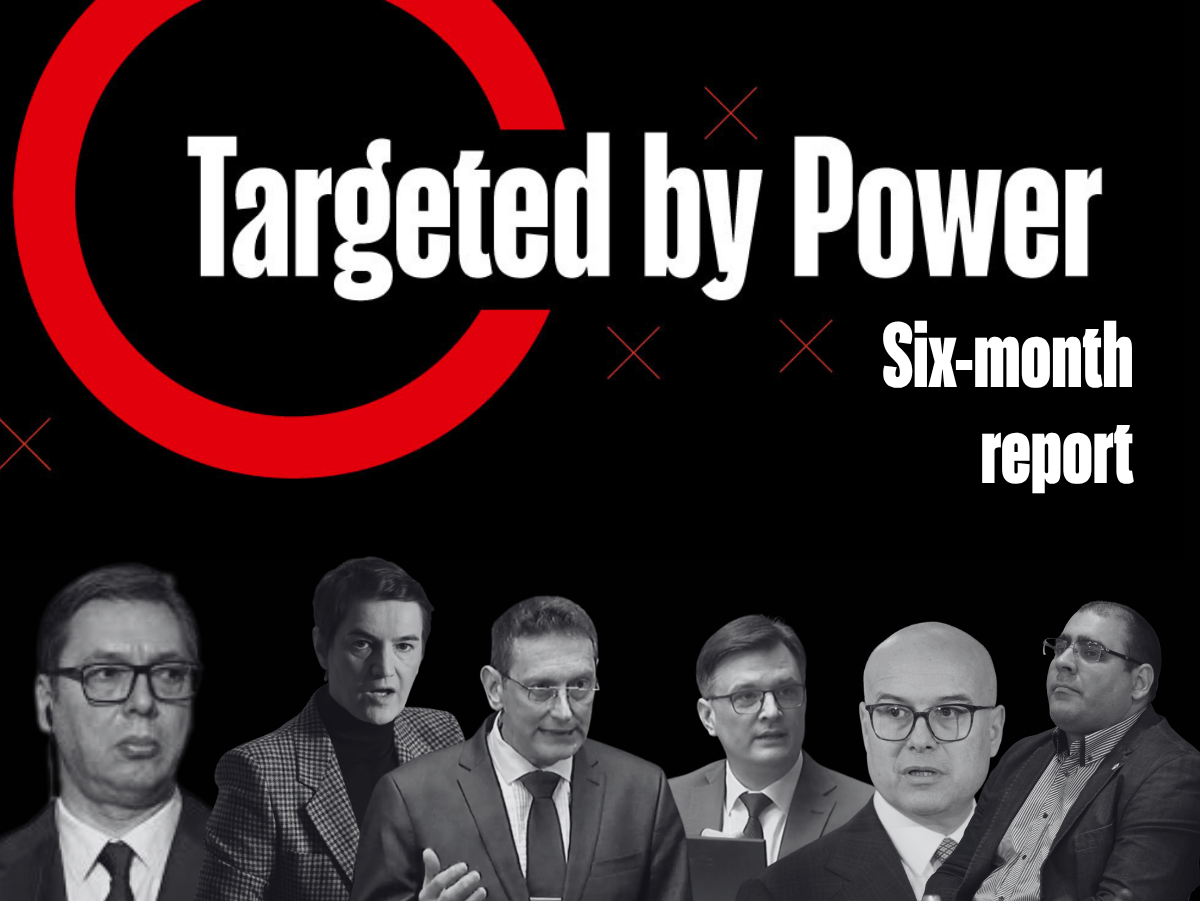
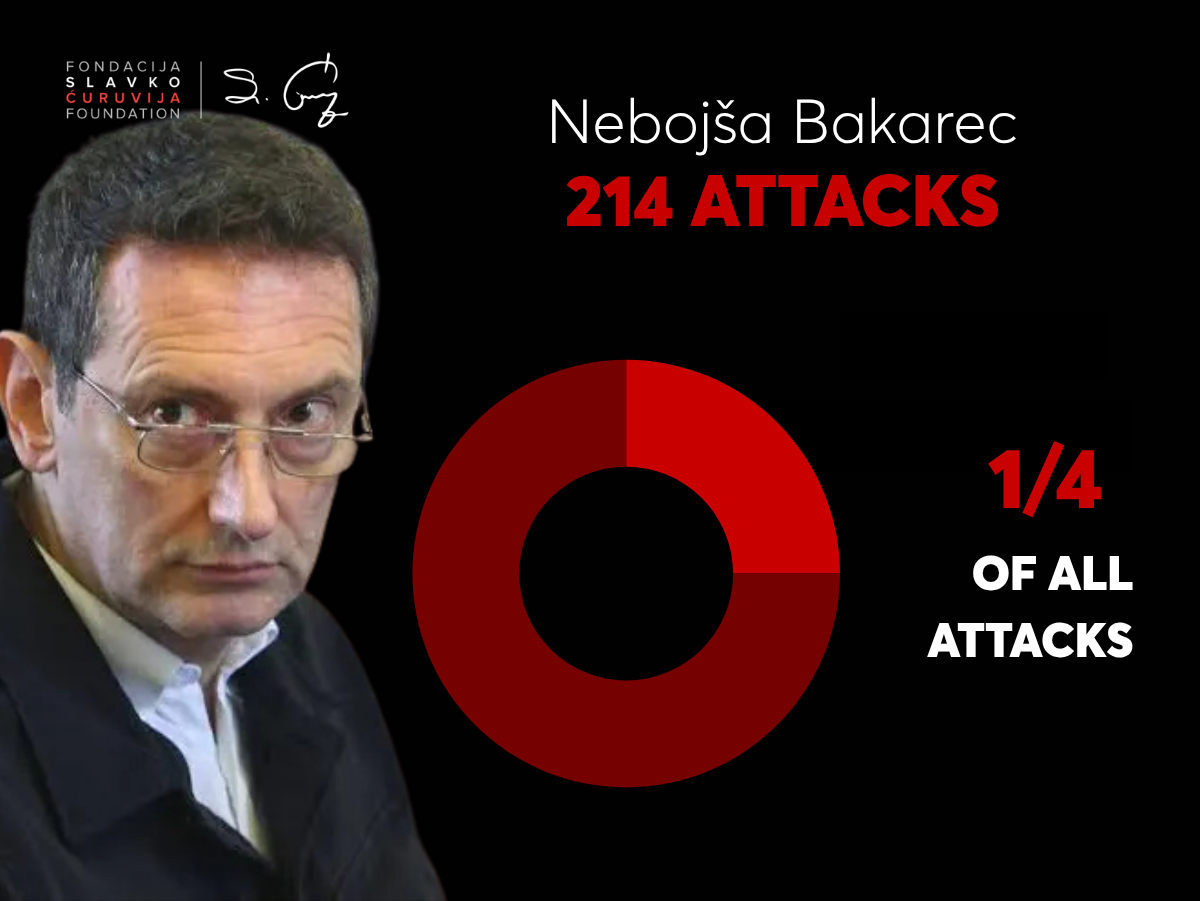
From 1 August 2025 to 31 January this year, the Slavko Ćuruvija Foundation recorded at least 834 verbal attacks by senior public officials against critically oriented journalists and media outlets in Serbia. At least 64 officials took part in daily insults, discrediting campaigns and baseless accusations targeting journalists and the media. The most frequent attacker was Nebojša Bakarec, who verbally targeted journalists and media outlets at least 214 times, accounting for a quarter of all recorded attacks. He was followed by Serbian Progressive Party (SNS) MP Vladimir Đukanović, President Aleksandar Vučić, SNS MP Milenko Jovanov, Speaker of Parliament Ana Brnabić, and SNS President Miloš Vučević. The most common targets were media outlets labelled by officials as “Šolak’s media”, primarily N1 and Nova S.
There is virtually no branch of government whose representatives were not involved in targeting journalists, from SNS MPs, who overwhelmingly led the attacks during parliamentary debates and on their social media accounts, to the leadership of the National Assembly, government ministers, and ultimately the President of the Republic himself. Over the past six months alone, at least 64 public officials took part in these attacks.
“Insects”, “liars”, “drug addicts”, “non-humans”, “terrorists”, “fascists”, “Nazis”, “traitors”, and “lunatics” were just some of the labels used by state officials to describe journalists.
The dominant narratives in these verbal attacks centred on discrediting journalists and media outlets by questioning their professionalism, independence and ethics, alongside dehumanisation, insults, branding journalists as traitors and foreign mercenaries, and even comparing them to fascists.
Particularly dangerous narratives over the past six months involved the criminalisation of journalists and media outlets, with public officials accusing certain newsrooms of inciting the most serious criminal offences, encouraging a violent overthrow of the government and bloodshed in the streets, and even preparing the media ground for Vučić’s assassination. At the same time, officials were calling on the prosecution authorities to take action against them.
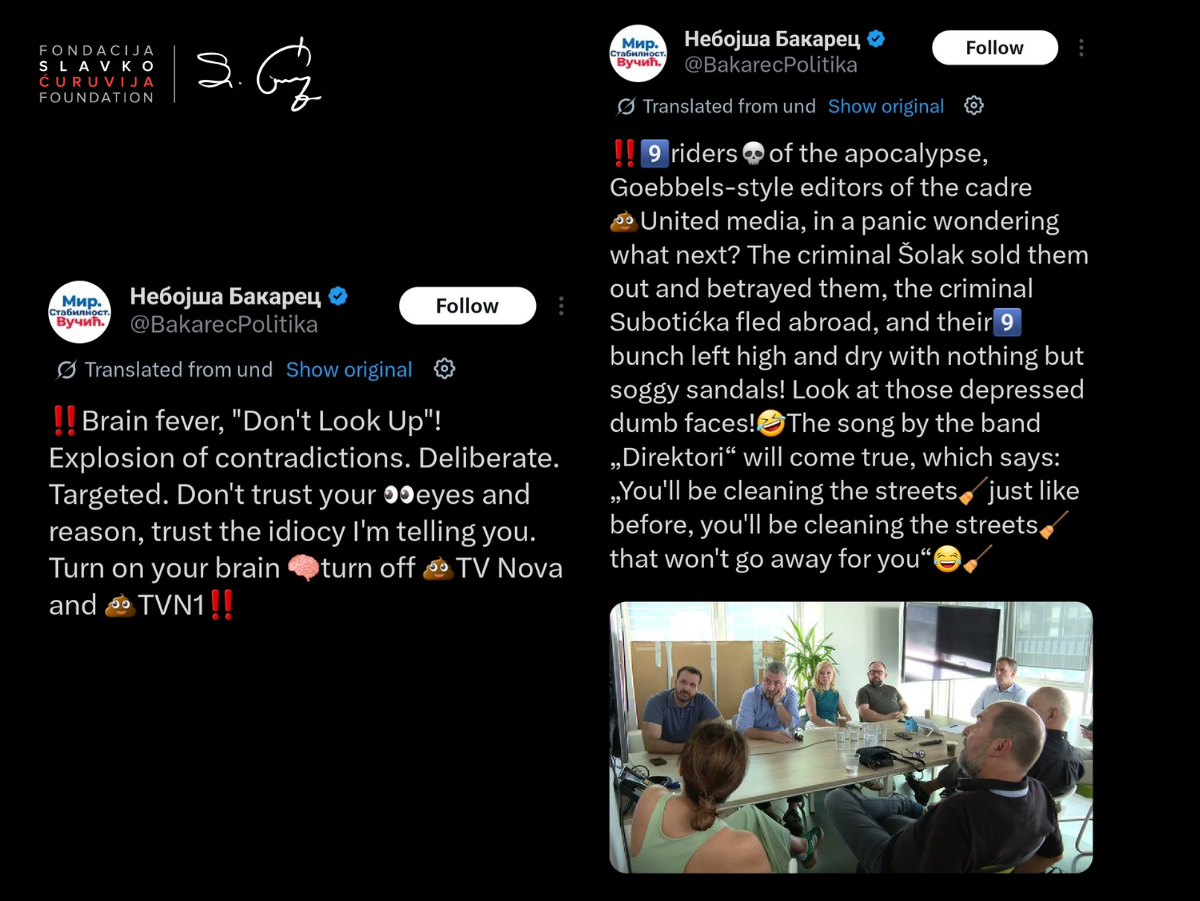
The undisputed leader in the number of attacks, Nebojša Bakarec, insulted, accused and discredited media outlets at least 214 times. He referred to N1 and Nova S as “filthy”, “villains”, “wretches”, “anti-Serbian propaganda outlets”, “Nazis” and “media trash”, called the daily Danas a “toiletloid”, and described RTS journalists as “scumbags”. He spared neither words nor emojis, repeating the same insults on Instagram and Twitter/X, in columns for Informer, in articles published on his own website, and during television appearances.
In September, Bakarec even accused N1 employees of attempted murder. “N1 TV has started killing! An N1 vehicle deliberately hit a police officer on a motorcycle,” Bakarec wrote.
In reality, the incident involved an N1 driver making a U-turn and knocking over a police officer on a motorcycle, as confirmed by street surveillance footage. In a statement, the newsroom expressed regret over the incident and wished the officer a speedy recovery.
He was followed by Vladimir Đukanović, with 114 verbal attacks over the previous six months, using similar rhetoric, albeit in a somewhat more restrained tone. Among the phrases he used were: “Šolak’s propaganda outlets”, “KRIK, a mouthpiece for Western agencies”, and “the disgusting communist RTS”. Danas editor Draža Petrović was described as “the unfortunate Draža Petrović, once a fervent Chetnik and now an ANTIFA beginner”, while N1 journalist Ana Novaković was labelled a “fake journalist”. Commenting on an article by Snežana Čongradin published in Danas, Đukanović wrote in October that it “should be analysed by a psychiatrist”, suggesting that the journalist should be institutionalised in a psychiatric hospital.
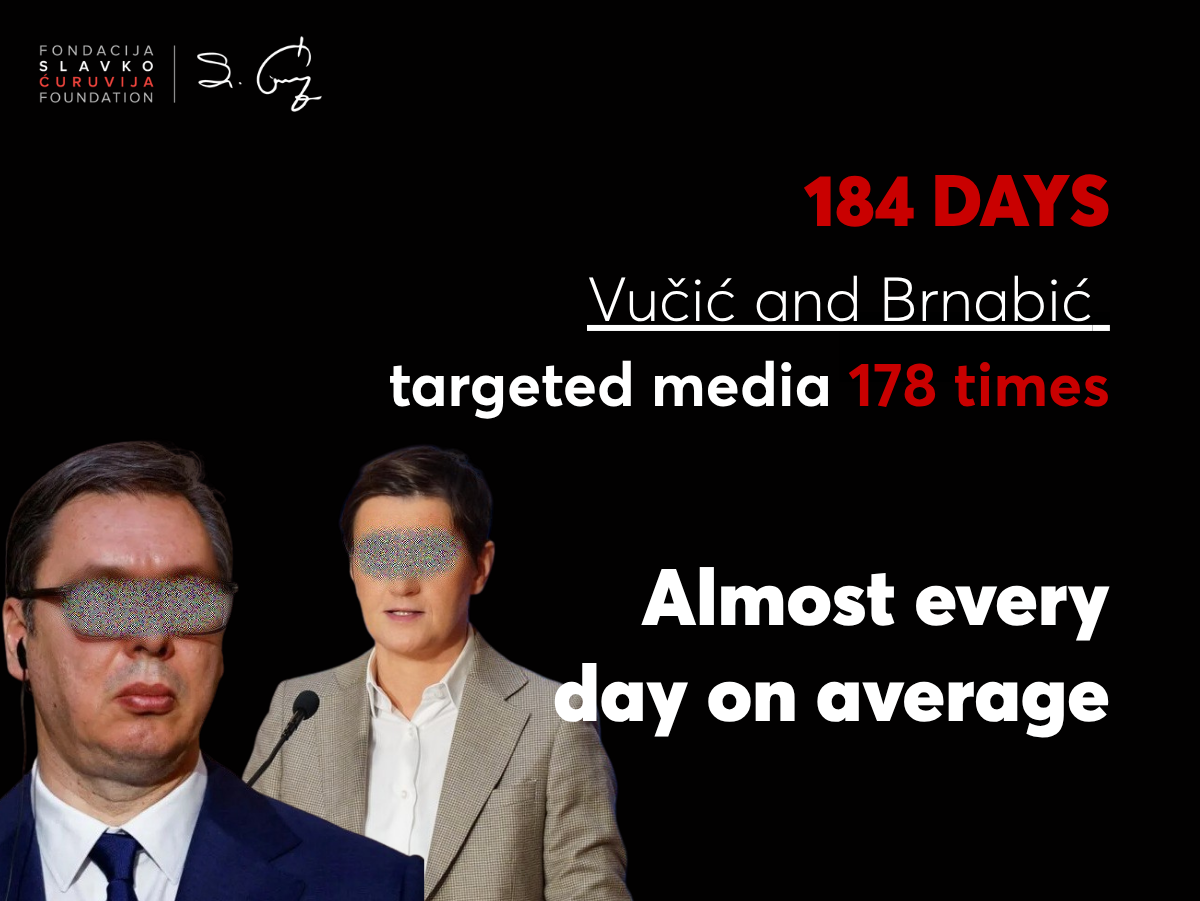
Although insults were the most common form of attack, somewhat less frequent – but potentially far more dangerous – were accusations that critically oriented media outlets were effectively outposts of foreign intelligence services working to overthrow the government. Such criminalising rhetoric also came on several occasions from the country’s most powerful officials, including President Aleksandar Vučić and President of Parliament Ana Brnabić. Together, the two targeted media outlets verbally 178 times, on average almost every day.
Aleksandar Vučić targeted journalists and media outlets at least 105 times through public statements, television appearances, Instagram posts and press conferences. Although his language was formally more restrained, the messages conveyed were similar. Vučić’s rhetoric tended to be more cynical, frequently referring to “certain media”, “Šolak’s media”, “liberal-anarchist”, “fake”, “occupation” and “criminal” media outlets.
From his position as the country’s de facto most powerful figure, the President repeatedly accused media outlets of undermining the constitutional order.
“N1 and Nova S have an agenda aimed at overthrowing the state,” Vučić said, before later, in September, openly calling on the prosecution authorities to take action against undesirable media outlets, while warning that the authorities would otherwise “deal with” the judiciary themselves.
“I have a question for our prosecutors – how long will they keep pretending to be naïve and fail to see what certain media platforms are doing by directly calling for lynching and confrontation with state institutions? I must say that I am waiting for a reaction from the prosecution. If there is none, we will have to undertake more serious measures at the state level, both regarding the prosecution and the judiciary”, Vučić said.
President of Parliament Ana Brnabić used similar rhetoric, accusing “the blockaders” and the “blockader Šolak media” of being responsible “for the riots and smashed heads” during protests. In October, she described them as “extremists” advocating the violent overthrow of the government and, following Vučić’s example, called on the prosecution authorities to react.
“They advocate violence in the streets solely because it is in the business interest of the man who pays them — Dragan Šolak”, the Presdient of Parliament said. “After such open calls for violence and the violent overthrow of the constitutional order, where is the prosecution, where are the institutions?”
Hand in hand with such labels came accusations from other state officials that critically oriented media outlets were effectively acting as outposts of foreign intelligence services, poisoning the public with lies and working to overthrow the government.
Researchers from the Foundation recorded at least 97 attacks by SNS MP Milenko Jovanov, at least 73 by President of Parliament Ana Brnabić, while SNS President Miloš Vučević attacked the media 51 times. In total, at least 64 public officials took part in these attacks.
N1 was directly targeted at least 220 times, while Nova and Nova S were targeted at least 130 times, making them the media outlets most consistently subjected to attacks on an almost daily basis. Other frequent targets included Danas, Radar, Vreme and RTS, while some outlets were attacked more sporadically, including KRIK, CINS, KTV Zrenjanin etc.
Media outlets were not the only targets – individual journalists were targeted as well. N1 journalist Žaklina Tatalović was the journalist most frequently dragged through the mud by public officials, primarily on social media, where they sought to discredit her work. Insults were also directed at Dinko Gruhonjić, journalist Sanja Eker and Slobodan Georgiev. We recorded at least forty targeted journalists and media workers, the vast majority of whom work for N1, Nova, Nova S, Danas, Radar and Vreme. They include Ana Novaković, Danica Vučenić, Draža Petrović, Filip Švarm, Igor Božić, Jelena Obućina, Marina Fratucan, Mladen Savatović, Nikola Radišić, Zoran Kesić, Vuk Cvijić, Željko Veljković and others.
It should also be noted that the figure of 834 verbal attacks represents only the minimum identified through the application of a predefined methodology limited by the resources available to us. The overall number of attacks is significantly higher. The monitoring covered a limited sample of media outlets and actors, including officials’ social media accounts and public appearances by those who stood out for repeatedly targeting journalists, parliamentary sessions, and the online portals of the tabloids Informer, Alo and Telegraf.